The following are my Term tests target scores for Science, my actual scores, and my reflections after reviewing my results.
Term 1
Target Score: 70, A2
Actual Score: 60, B4
Reflections:
I feel that I had gotten such a score mainly because the Term topic was Chemistry, and I was quite weak at it. Also, I did not clarify any doubts, which was why I did not score well. I will work harder in future, and for the following Terms, and I will concentrate harder during lessons.
Term 2
Target Score: 70, A2
Actual Score: 76, A1
I feel that I managed to achieve a score which was higher than what I was targeting for because the Term topic was Biology, which was a topic I was more familiar with, and that I concentrated harder during lessons.
Term 3
Target Score: 65
Actual Score: 66
I feel that I should have set my target higher, even though I was not good at Physics, as that would most probably have a more positive impact on my actual results. I am not too satisfied with my results, and promise myself to work harder for the End-Of-Year examination paper for Science, in which all three topics, Chemistry, Biology, and Physics will be tested. I will review my past mistakes, and clarify any doubts with the teacher. Also, I will make an effort not to repeat past mistakes and errors.
Term 4 End-Of-Year Examinations
Target Score: 75
Tuesday, August 23, 2011

Monday, August 22, 2011
Reflections on Laboratory Practical Lessons
In 2011, my class was lucky, as we managed to have one Science Field Trip in Term 2 for Ecology, due to the fact that we it was after our Science test and thus we had it on a holiday. However, we also had practical lessons every week for Chemistry and Physics.
For Chemistry, we started off with acid and bases and learn the basics but important reactions between Acids, Bases, Metals and Carbons. It was really wonderful to look at the reactions being carried out during these lessons. It was not really interesting as it used to be as we were doing acids and bases over the whole term, however the good thing was that we were able to do the experiment on our own and could be amazed by our results. This was something that could never be achieved no matter how vividly and excitingly the textbook describes the experiment. It was both enjoyable and fruitful for the practical lessons.
In Physics, we carried out many experiments on light, which was rather interesting. Even though I found Physics a moderately challenging Science topic, I have an interest in it and I will strive to do well in it.
It was extremely fun to see the different reactions on the reflected light beams when we shifted the positioning of the incident ray.
In these practical lessons, we were thought not too look at one angle but many other and not to be narrow-minded. It tells us that Science is limitless and something new can happen anytime and it is up to us, to find out how it happened. It also teaches us that getting an A1 is not as important as having fun and continuously learning and find out more on the topics.
For Chemistry, we started off with acid and bases and learn the basics but important reactions between Acids, Bases, Metals and Carbons. It was really wonderful to look at the reactions being carried out during these lessons. It was not really interesting as it used to be as we were doing acids and bases over the whole term, however the good thing was that we were able to do the experiment on our own and could be amazed by our results. This was something that could never be achieved no matter how vividly and excitingly the textbook describes the experiment. It was both enjoyable and fruitful for the practical lessons.
In Physics, we carried out many experiments on light, which was rather interesting. Even though I found Physics a moderately challenging Science topic, I have an interest in it and I will strive to do well in it.
It was extremely fun to see the different reactions on the reflected light beams when we shifted the positioning of the incident ray.
In these practical lessons, we were thought not too look at one angle but many other and not to be narrow-minded. It tells us that Science is limitless and something new can happen anytime and it is up to us, to find out how it happened. It also teaches us that getting an A1 is not as important as having fun and continuously learning and find out more on the topics.
Monday, August 8, 2011
Lenses
Recently, in Term 3, under the topic Physics, I was taught about lenses, which I find an extremely eye-opening topic. I enjoy learning about lenses, as it is quite simple to understand what I have been taught so far, and I really like the topic. I have been taught that there are two different types of lenses, converging and diverging lenses. Converging lenses allow light rays which pass through to converge at a single principal focus, while light rays which pass through diverging lenses diverge except for the centre ray. Converging lenses are widely used in our daily lives, and each converging lens also has a different focal point. Through various practical experiments which were conducted in the Science Laboratory, I have learned that a different positioning of the object from the lens will result in a different form of the image.
 I learned that if the object distance from the converging lens is more than twice the focal length, the image formed will be real, as it can be projected on a screen. It will also be smaller than the original object and it will be inverted.
 Next, I learned that if the object distance from the converging lens is equal to twice the focal length, the image formed will be real, as it can be projected on a screen as well. It will also be the same size as that of the object, and it will be inverted.
 As for if the object distance from the converging lens would be less than twice the focal length but more then the focal length, the image formed would still be real, as it can be projected on a screen as well. However, it will appear bigger, but remains inverted.
 Next, if the object distance from the converging lens were to be less than the focal length, the image formed this time would be virtual, not being able to be projected on a screen. It would also be bigger and upright. Such an application in our daily lives is the magnifying glass, as it is held closer to the object than the focal length to allow a bigger image that is upright to be formed.
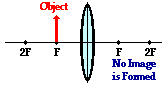
 Finally, I was taught that when the object distance to the converging lens is the same as the focal length, there would be no image formed.

Reflection of Light

For example, an instance of reflection being applied in our daily lives is when ambulances have the word 'AMBULANCE' printed laterally inverted on their bonnets. This is so that drivers in front of it can read it correctly as 'AMBULANCE' and react quickly, by giving way, etc. Also, reflection is also important, as without reflection, we would not know how we look like in the first place, or see objects that we are not able to see with mirrors. Another example would be a periscope, which is used in submarines, for the people inside to make use of the laws of reflection to see objects above water even when the submarine is submerged in water. Although this is a complicated topic, I find it extremely intriguing, and therefore I am constantly trying to find out more on reflection.
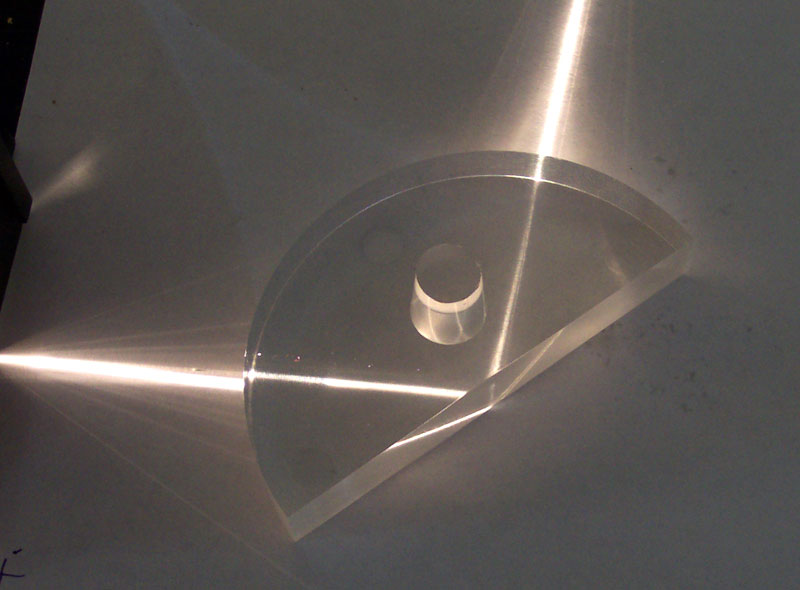
In addition, I also learned about total internal reflection, which occurs only when the angle of incidence is greater than the critical angle for the medium. This is extremely interesting, as it is intriguing how the light ray does not emerge from the other end of the semicircular block, and instead gets totally internally reflected. I am excited about this topic, and would like to find out more.
Sunday, August 7, 2011
Refraction of Light


Saturday, August 6, 2011
The Rainbow Spectrum


The colours of rainbows and spectrums are as follows, red, orange, yellow, green, blue, indigo, violet. They are as such due to the fact that red light has the longest wavelength and violet light has the shortest wavelength, so violet light bends closer towards the normal.

Monday, August 1, 2011
Rockets- How they fly in Space
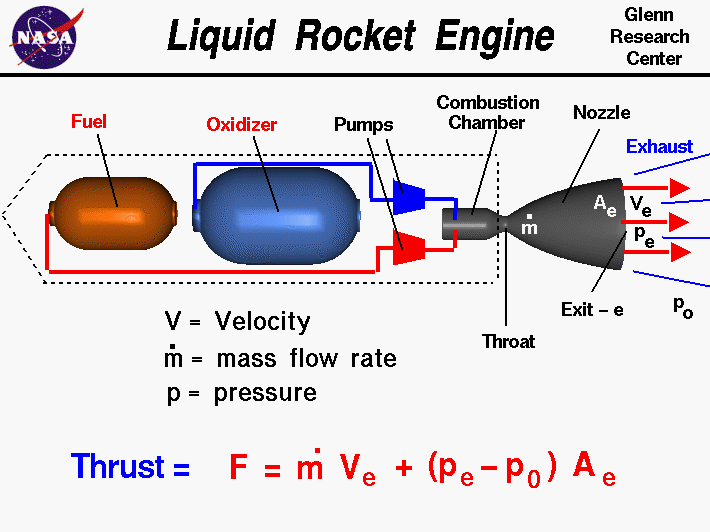

I found out that in a rocket's engine, a fuel propellant is burned with an oxidizer propellant to produce large volumes of very hot gas. The hot gas that is ejected from the rocket engine acts as a propellant, and produces thrusts for the rocket, to make it move. The hot gases that are ejected from the engine expand accelerates them until they rush out of the back of the rocket at extremely high speeds, propelling the rocket forwards. During takeoff, however, the rocket makes use of its liquid hydrogen and oxygen tanks to boost themselves out of the Earth's gravitational field.
Subscribe to:
Comments (Atom)