
Recently, in Term 3, I was taught by my Science teacher an interesting topic in Physics, which is reflection of light. I am extremely interested in this topic, and would like to find out more. Currently, I have been taught that a parallel beam of light will be reflected as a parallel beam still if it hits a smooth surface. This is why a shiny and polished surface would appear to be glossier to the human eye than a dull and rough surface. Secondly, I was taught that reflections of objects on a plane mirror are always laterally inverted. Also, I was taught that the incident ray, reflected ray, and the normal lie on the same plane, and that the angle of incidence, which is between the incident ray and the normal, is equal to the angle of reflection. Furthermore, I learned that the laws of reflection do not apply to just the plane mirror, but other forms of mirrors like the concave and convex mirror. My teacher taught us that we must draw tangents while applying the laws of reflection to a concave or convex mirror. Although reflection may seem like a boring topic, which was my first impression of the topic, it is important to have a basic understand of reflection, as it is used in our daily lives.
For example, an instance of reflection being applied in our daily lives is when ambulances have the word 'AMBULANCE' printed laterally inverted on their bonnets. This is so that drivers in front of it can read it correctly as 'AMBULANCE' and react quickly, by giving way, etc. Also, reflection is also important, as without reflection, we would not know how we look like in the first place, or see objects that we are not able to see with mirrors. Another example would be a periscope, which is used in submarines, for the people inside to make use of the laws of reflection to see objects above water even when the submarine is submerged in water. Although this is a complicated topic, I find it extremely intriguing, and therefore I am constantly trying to find out more on reflection.
Total Internal Reflection
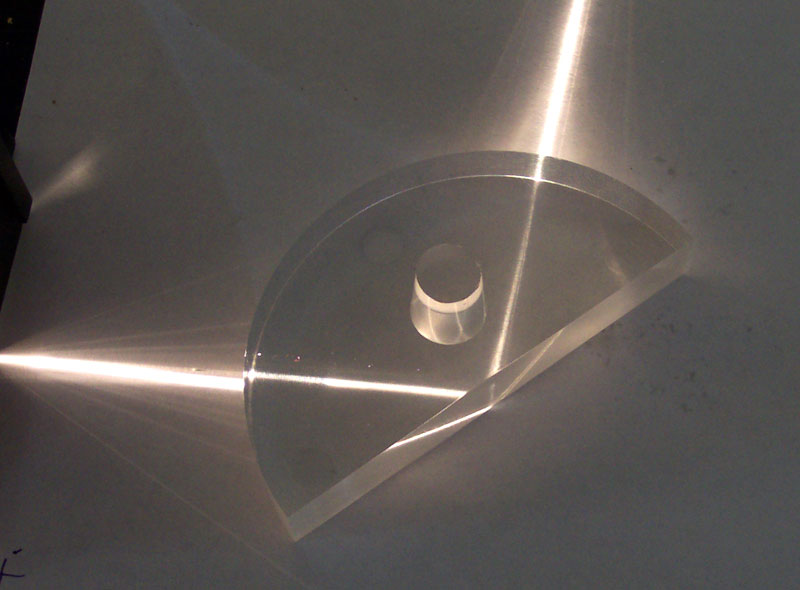
In addition, I also learned about total internal reflection, which occurs only when the angle of incidence is greater than the critical angle for the medium. This is extremely interesting, as it is intriguing how the light ray does not emerge from the other end of the semicircular block, and instead gets totally internally reflected. I am excited about this topic, and would like to find out more.


No comments:
Post a Comment