
Saturday, September 3, 2011
Why I enjoy learning Science

GMAC Students Challenge 2011
This year, some time back in Term 2, there was a Science Challenge from the Genetic Modification Advisory Committee of Singapore (GMAC), which was an inter-school educational video creation. The GMAC seeks to educate the public on gene modification technology and genetically modified organisms, from a neutral and objective standpoint that is based on sound Science. Together with 4 other classmates, I led my group, as the team leader to research more on genetically modified crops, and together, we put together a 9 minute video about genetically modified crops. My obtained a certificate of participation from the GMAC as well, which was awarded to us on the 3rd of September. Throughout this strenuous process of combining our efforts to make the video, I learned much more on genetically modified crops, as well as it was a team building experience for me and my team mates, and I really enjoyed this project. I have a deep interest in such projects, and I will sign up for such activities in the future.
My group mates are-
Chew Tianle (2i3, 2)
Lee Wei Ren (2i3, 11)
Low Wei Yang (2i3, 13) (Me, leader)
Ng Shen Han (2i3, 16)
Ong Yan Zhe (2i3, 20)
The following is my group's video product, so please enjoy!
My group mates are-
Chew Tianle (2i3, 2)
Lee Wei Ren (2i3, 11)
Low Wei Yang (2i3, 13) (Me, leader)
Ng Shen Han (2i3, 16)
Ong Yan Zhe (2i3, 20)
The following is my group's video product, so please enjoy!
Tuesday, August 23, 2011
Term Targets and Results
The following are my Term tests target scores for Science, my actual scores, and my reflections after reviewing my results.
Term 1
Target Score: 70, A2
Actual Score: 60, B4
Reflections:
I feel that I had gotten such a score mainly because the Term topic was Chemistry, and I was quite weak at it. Also, I did not clarify any doubts, which was why I did not score well. I will work harder in future, and for the following Terms, and I will concentrate harder during lessons.
Term 2
Target Score: 70, A2
Actual Score: 76, A1
I feel that I managed to achieve a score which was higher than what I was targeting for because the Term topic was Biology, which was a topic I was more familiar with, and that I concentrated harder during lessons.
Term 3
Target Score: 65
Actual Score: 66
I feel that I should have set my target higher, even though I was not good at Physics, as that would most probably have a more positive impact on my actual results. I am not too satisfied with my results, and promise myself to work harder for the End-Of-Year examination paper for Science, in which all three topics, Chemistry, Biology, and Physics will be tested. I will review my past mistakes, and clarify any doubts with the teacher. Also, I will make an effort not to repeat past mistakes and errors.
Term 4 End-Of-Year Examinations
Target Score: 75
Term 1
Target Score: 70, A2
Actual Score: 60, B4
Reflections:
I feel that I had gotten such a score mainly because the Term topic was Chemistry, and I was quite weak at it. Also, I did not clarify any doubts, which was why I did not score well. I will work harder in future, and for the following Terms, and I will concentrate harder during lessons.
Term 2
Target Score: 70, A2
Actual Score: 76, A1
I feel that I managed to achieve a score which was higher than what I was targeting for because the Term topic was Biology, which was a topic I was more familiar with, and that I concentrated harder during lessons.
Term 3
Target Score: 65
Actual Score: 66
I feel that I should have set my target higher, even though I was not good at Physics, as that would most probably have a more positive impact on my actual results. I am not too satisfied with my results, and promise myself to work harder for the End-Of-Year examination paper for Science, in which all three topics, Chemistry, Biology, and Physics will be tested. I will review my past mistakes, and clarify any doubts with the teacher. Also, I will make an effort not to repeat past mistakes and errors.
Term 4 End-Of-Year Examinations
Target Score: 75
Monday, August 22, 2011
Reflections on Laboratory Practical Lessons
In 2011, my class was lucky, as we managed to have one Science Field Trip in Term 2 for Ecology, due to the fact that we it was after our Science test and thus we had it on a holiday. However, we also had practical lessons every week for Chemistry and Physics.
For Chemistry, we started off with acid and bases and learn the basics but important reactions between Acids, Bases, Metals and Carbons. It was really wonderful to look at the reactions being carried out during these lessons. It was not really interesting as it used to be as we were doing acids and bases over the whole term, however the good thing was that we were able to do the experiment on our own and could be amazed by our results. This was something that could never be achieved no matter how vividly and excitingly the textbook describes the experiment. It was both enjoyable and fruitful for the practical lessons.
In Physics, we carried out many experiments on light, which was rather interesting. Even though I found Physics a moderately challenging Science topic, I have an interest in it and I will strive to do well in it.
It was extremely fun to see the different reactions on the reflected light beams when we shifted the positioning of the incident ray.
In these practical lessons, we were thought not too look at one angle but many other and not to be narrow-minded. It tells us that Science is limitless and something new can happen anytime and it is up to us, to find out how it happened. It also teaches us that getting an A1 is not as important as having fun and continuously learning and find out more on the topics.
For Chemistry, we started off with acid and bases and learn the basics but important reactions between Acids, Bases, Metals and Carbons. It was really wonderful to look at the reactions being carried out during these lessons. It was not really interesting as it used to be as we were doing acids and bases over the whole term, however the good thing was that we were able to do the experiment on our own and could be amazed by our results. This was something that could never be achieved no matter how vividly and excitingly the textbook describes the experiment. It was both enjoyable and fruitful for the practical lessons.
In Physics, we carried out many experiments on light, which was rather interesting. Even though I found Physics a moderately challenging Science topic, I have an interest in it and I will strive to do well in it.
It was extremely fun to see the different reactions on the reflected light beams when we shifted the positioning of the incident ray.
In these practical lessons, we were thought not too look at one angle but many other and not to be narrow-minded. It tells us that Science is limitless and something new can happen anytime and it is up to us, to find out how it happened. It also teaches us that getting an A1 is not as important as having fun and continuously learning and find out more on the topics.
Monday, August 8, 2011
Lenses
Recently, in Term 3, under the topic Physics, I was taught about lenses, which I find an extremely eye-opening topic. I enjoy learning about lenses, as it is quite simple to understand what I have been taught so far, and I really like the topic. I have been taught that there are two different types of lenses, converging and diverging lenses. Converging lenses allow light rays which pass through to converge at a single principal focus, while light rays which pass through diverging lenses diverge except for the centre ray. Converging lenses are widely used in our daily lives, and each converging lens also has a different focal point. Through various practical experiments which were conducted in the Science Laboratory, I have learned that a different positioning of the object from the lens will result in a different form of the image.
 I learned that if the object distance from the converging lens is more than twice the focal length, the image formed will be real, as it can be projected on a screen. It will also be smaller than the original object and it will be inverted.
 Next, I learned that if the object distance from the converging lens is equal to twice the focal length, the image formed will be real, as it can be projected on a screen as well. It will also be the same size as that of the object, and it will be inverted.
 As for if the object distance from the converging lens would be less than twice the focal length but more then the focal length, the image formed would still be real, as it can be projected on a screen as well. However, it will appear bigger, but remains inverted.
 Next, if the object distance from the converging lens were to be less than the focal length, the image formed this time would be virtual, not being able to be projected on a screen. It would also be bigger and upright. Such an application in our daily lives is the magnifying glass, as it is held closer to the object than the focal length to allow a bigger image that is upright to be formed.
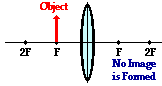
 Finally, I was taught that when the object distance to the converging lens is the same as the focal length, there would be no image formed.

Reflection of Light

For example, an instance of reflection being applied in our daily lives is when ambulances have the word 'AMBULANCE' printed laterally inverted on their bonnets. This is so that drivers in front of it can read it correctly as 'AMBULANCE' and react quickly, by giving way, etc. Also, reflection is also important, as without reflection, we would not know how we look like in the first place, or see objects that we are not able to see with mirrors. Another example would be a periscope, which is used in submarines, for the people inside to make use of the laws of reflection to see objects above water even when the submarine is submerged in water. Although this is a complicated topic, I find it extremely intriguing, and therefore I am constantly trying to find out more on reflection.
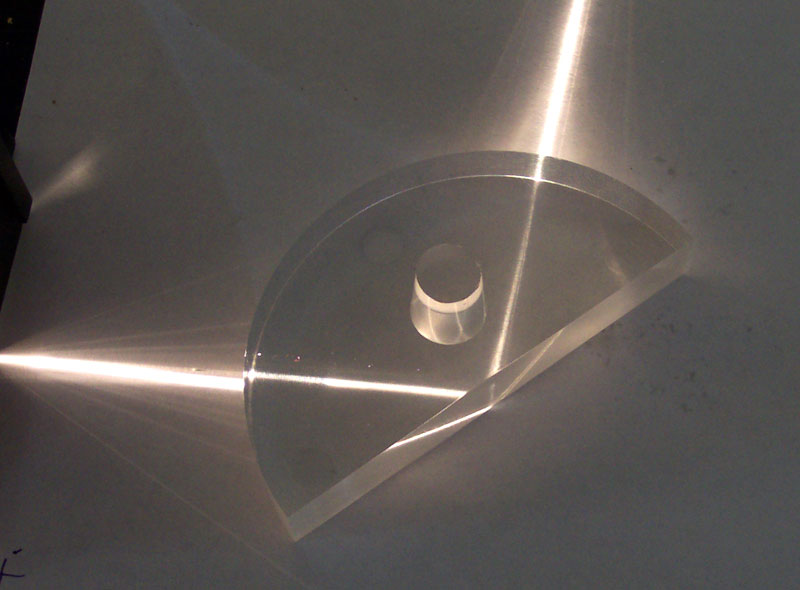
In addition, I also learned about total internal reflection, which occurs only when the angle of incidence is greater than the critical angle for the medium. This is extremely interesting, as it is intriguing how the light ray does not emerge from the other end of the semicircular block, and instead gets totally internally reflected. I am excited about this topic, and would like to find out more.
Sunday, August 7, 2011
Refraction of Light


Saturday, August 6, 2011
The Rainbow Spectrum


The colours of rainbows and spectrums are as follows, red, orange, yellow, green, blue, indigo, violet. They are as such due to the fact that red light has the longest wavelength and violet light has the shortest wavelength, so violet light bends closer towards the normal.

Monday, August 1, 2011
Rockets- How they fly in Space
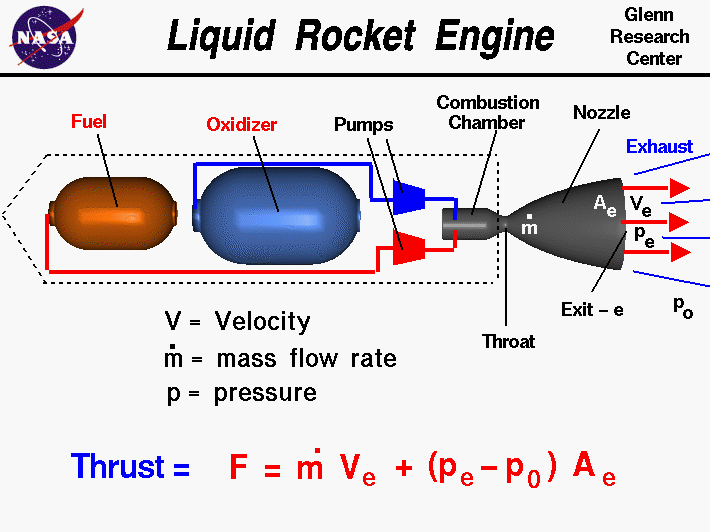

I found out that in a rocket's engine, a fuel propellant is burned with an oxidizer propellant to produce large volumes of very hot gas. The hot gas that is ejected from the rocket engine acts as a propellant, and produces thrusts for the rocket, to make it move. The hot gases that are ejected from the engine expand accelerates them until they rush out of the back of the rocket at extremely high speeds, propelling the rocket forwards. During takeoff, however, the rocket makes use of its liquid hydrogen and oxygen tanks to boost themselves out of the Earth's gravitational field.
Friday, July 29, 2011
Time Travel

What is time travel? Is it possible? Time travel is the concept of moving between different points in time in a manner analogous to moving between different points in space, either sending objects or information backwards in time to some moment before the present or sending objects forward from the present to the future without the need to experience the intervening period at the normal rate. It is quite a thought evoking topic and therefore I have decided to include it under Term 3's Physics topic on my Science E-Portfolio. Many believe that time travel is possible, as there is a scientific hypothesis that as long as an object would be faster than light, it could travel through time. However, Albert Einstein once said that “the speed of light was the traffic law of the universe.” This means that nothing can travel faster than light. Is this true?

The speed of light is approximately 186282 miles a second. It is supposedly the fastest of any matter, energy, or information known in the universe. Our modern day technology is constantly improving, and thus scientists have new means to try out such experiments, such as trying to make objects move at the speed of light, using advanced machinery.

Another supposed way of time travel is via wormholes. A wormhole is a hypothetical topological feature of space-time that would be, fundamentally, a "shortcut" through space-time. The theory of general relativity predicts that if traversable wormholes exist, they could allow time travel. This would be accomplished by accelerating one end of the wormhole to a high velocity relative to the other, and then sometime later bringing it back; relativistic time dilation would result in the accelerated wormhole mouth aging less than the stationary one as seen by an external observer, similar to what is seen in the twin paradox. However, time connects differently through the wormhole than outside it, so that synchronized clocks at each mouth will remain synchronized to someone travelling through the wormhole itself, no matter how the mouths move around. This means that anything which entered the accelerated wormhole mouth would exit the stationary one at a point in time prior to its entry. However, a wormhole is thought to have an extremely strong gravitational field, which will cause objects to compress into long thin shapes, which is also known as ‘spaghettification’. In the most extreme cases, such as these worm holes, the stretching is so powerful that no object can withstand it. It is thought that it may not be possible to convert a wormhole into a time machine in this manner; the predictions are made in the context of general relativity, but general relativity does not include quantum effects.

I have found in a news article, that Hong Kong physicists say they have proved that a single photon obeys Einstein's theory that nothing can travel faster than the speed of light, demonstrating that outside science fiction, time travel is impossible.
The Hong Kong University of Science and Technology research team led by Du Shengwang said they had proved that a single photon, or unit of light, "obeys the traffic law of the universe". They said on their website that Einstein claimed that nothing could go faster than light. Professor Du's study demonstrates that a single photon, the fundamental quanta of light, also obeys the traffic law of the universe just like classical electro-magnetic waves. The possibility of time travel was raised a decade ago when scientists discovered superluminal (faster than light) propagation of optical pulses in some specific medium the science team said. It was later found to be a visual effect, but researchers thought it might still be possible for a single photon to exceed light speed. Professor Du, however, believed Einstein was right and determined to end the debate by measuring the ultimate speed of a single photon, which had not been done before.
Quoted from them,
"The study, which showed that single photons also obey the speed limit c, confirms Einstein's causality; that is, an effect cannot occur before its cause," the university said.
"By showing that single photons cannot travel faster than the speed of light, our results bring a closure to the debate on the true speed of information carried by a single photon," said Du, assistant professor of physics.
"Our findings will also likely have potential applications by giving scientists a better picture on the transmission of quantum information."
Reflections:
I feel that this topic is indeed intriguing, as time travel is an extremely complex topic under physics, which is why I find it very puzzling yet interested to find out more because of this. I believe that although it seems impossible to travel through time even with today’s modern day advanced technology, it will become possible in the near-future when our future society’s scientists explore deeper into the secrets of light and wormholes and find out more important information which might aid us in finding a way to travel through time. Although our current scientists have yet to find a matter or energy which can travel at the rapid speed of light, or find a way to enter wormholes without getting spaghettified and instantly being stretched apart, I have high hopes for the future scientists and our future technology, and I believe that it is possible to travel through time in the future.
Earthquakes and Tsunamis

What is an earthquake? Why does it even occur when our ground is solid? Well, an earthquake is the result of a sudden release of energy in the Earth's crust that creates seismic waves. It is an important area in Physics, and therefore I have decided to include in under Term 3's Physics topic in my Science E-Portfolio. The seismicity or seismic activity of an area refers to the frequency, type and size of earthquakes experienced over a period of time. Earthquakes are measured using observations from seismometers. The moment magnitude is the most common scale on which earthquakes larger than approximately 5 are reported for the entire globe. The more numerous earthquakes smaller than magnitude 5 reported by national seismological observatories are measured mostly on the local magnitude scale, also referred to as the Richter scale. These two scales are numerically similar over their range of validity. Magnitude 3 or lower earthquakes are mostly almost imperceptible and magnitude 7 and over potentially causes serious damage over large areas, depending on their depth. The largest earthquakes in historic times have been of magnitude slightly over 9, although there is no limit to the possible magnitude. The most recent large earthquake of magnitude 9.0 or larger was a 9.0 magnitude earthquake in Japan in March 2011, and it was the largest Japanese earthquake since records began. Intensity of shaking is measured on the modified Mercalli scale. The shallower an earthquake, the more damage to structures it causes, all else being equal. At the Earth's surface, earthquakes manifest themselves by shaking and sometimes displacement of the ground. Earthquakes can also trigger landslides, and occasionally volcanic activity. Earthquakes usually occur in neighbouring countries of Singapore as well, such as the recent Sumatra earthquake in Indonesia, which happened in 2007. Singapore faced tremors from this earthquake, and vibrations could be felt from structures built on artificial reclaimed land, such as One Raffles Quay.

What is a tsunami, then, and how is it related to an earthquake? When the epicenter of a large earthquake is located offshore, the seabed may be displaced sufficiently to cause a tsunami. It is derived from a Japanese term, which also means ‘harbour wave’. Tsunamis are also known as tidal waves, and are extremely common in earthquake prone countries. They are caused by underwater explosions of any sort, be it volcanoes, bombs, meteorites or earthquakes.
A tsunami can be generated when the sea floor abruptly deforms and vertically displaces the overlying water. Tectonic earthquakes are a particular kind of earthquake that are associated with the Earth's crustal deformation; when these earthquakes occur beneath the sea, the water above the deformed area is displaced from its equilibrium position. More specifically, a tsunami can be generated when thrust faults associated with convergent or destructive plate boundaries move abruptly, resulting in water displacement, owing to the vertical component of movement involved. Movement on normal faults will also cause displacement of the seabed, but the size of the largest of such events is normally too small to give rise to a significant tsunami. A tsunami can be humongous, giving it its name as the ‘tidal’ wave. Tidal waves usually travel up to 700km/h and can rise as high as up to 30 metres as it approaches land, and apart from capsizing large ships, it can destroy structures on land and kills many people.
Reflections:
I feel that although earthquakes and tsunamis destroy our structures and kill many innocent lives, they are inevitable as they are part of nature, being natural disasters which come about naturally. I believe this is an interesting topic in physics, as it is amazing how an earthquake can cause a tsunami, such a large and titanic wave which causes much devastation even on land. These tidal waves can even bring down small buildings and tear down houses, as I recently saw in documentaries i=of the recent 2011 Japan earthquake and tsunami incident. Although this was extremely devastating and killed many and caused many to lose their homes in Japan, I am impressed by the Japan citizen’s calm reactions towards this shocking incident, and I feel that this is the way that everyone should react when facing such an incident, as such natural disasters are inevitable and neither can we blame nature for this happening. However, I am interested to find out more on such occurrences, as I am extremely intrigued by how earthquakes are formed, as it is an interesting part of physics, when the tectonic plates underground can shift and cause such massive destruction. Overall, I believe that earthquakes and tsunamis are extremely interesting, although deadly.
Saturday, July 16, 2011
Cockroaches- Key to Future Antibiotics

After going through tests, scientists have discovered that the tissue from the brains and nervous system of the cockroaches had killed more than 90% of the tested bacteria without damaging any human cells. The scientists were not surprised that the insects could naturally secrete their own antimicrobial drugs.
As cockroaches live in unsanitary and harsh environments, they often encounter many different types of bacteria. It would therefore be logical that they developed themselves against micro-organisms.
This topic interests me, as the thought of how an insect as dirty as the cockroach could be used in antibiotics to treat humans is shocking, yet the results of doing that would be very effective.
Tuesday, May 24, 2011
Ecosystems- Abiotic and biotic influences

So basically, these organisms would be interdependent, and energy is transferred from one organism to another mainly through feeding. And as we all know, the Sun is the main source of energy for Earth, and solar energy from the Sun is absorbed by plants, which are producers, and passed on to other organisms as chemical energy. Most of this energy is eventually lost as heat, and this energy flow is non cyclical.
Abiotic Environment
First of all, my Science teacher had gave us an in-depth explanation about the abiotic factors which influence the livelihood of organisms in a community or ecosystem.
- I had learned that the temperature and the pH would be an influencing factor, as they affect the proper functioning of enzymes. Also, extreme temperatures and pH levels disrupt the hydrophobic, hydrophilic, and ionic interactions in enzymes, causing them to lose shape and functionality.
- Next, I was taught that the amount of oxygen context is also an important factor. This is because oxygen is required for aerobic respiration by all organisms, and a lack of oxygen would slow down metabolism.
- Following this, the humidity of an environment is also impacting. A high humidity would slow down the rate of transpiration in plants but is also critical to the survival of epiphytes and organisms living in arid places.
- Another important factor would be the availability and amount of water. This is because water content affects the number and locations of flora and fauna. This is dependent on the rain pattern.
- The wave action also is another factor. Greater wave action would prevent marine organisms from settling down and feeding.
- The wind speed of the environment is another important factor. High wind speeds might break the stems of certain plant species and might also dissipate humidity.
- Next, the light intensity is an influencing factor as well. A low light intensity would adversely affect plant growth, but high light intensity might instead bleach chlorophyll and impairs the ability of plants to photosynthesize.
- The following factor that affects life in an ecosystem is the salinity level. The salinity level affects the osmotic balance in many aquatic animals and coastal plant species.
- Lastly, the type of substratum also influences life a community. A clayey, sandy or rocky substratum would influence the ability of plants and sessile organisms to anchor themselves.
Biotic Environment
I also was taught about the biotic factors which arise from interactions between organisms. The outcomes of these interaction might increase, decrease, or make no difference to the ability to grow, survive and other benefits to the fitness of either or both organisms. There are 5 different kinds of biotic factors which can positively or adversely affect organisms.
- Mutualism is when both organisms depend on each other and gain benefits from doing so. An example would be the relationship between sea anemones and clownfish. The sea anemones provide clownfish with protection from predators, as normal fish cannot tolerate the stings from the anemones' tentacles but clownfish have a layer of mucus on their body which helps them to be unaffected by the anemones. In return, the clownfish help to eat up the symbiotic algae which is found on the sea anemones' tentacles.
- Commensalism is when one organism depends on another to gain benefits, however the other organism is neutral. For instance, mosses are plants which have a commensal relationship with trees. They usually grow on the trunks and branches of trees, where they get sufficient sunlight and nutrients. As long as they do not grow too heavy, the trees are not affected.
- Exploitative relationships such as predation, parasitism, and herbivory is when one organism benefits, while the other is adversely affected. An example of predation is the relationship between snakes and rabbits, where snakes prey on rabbits, and benefit while the rabbits decrease in population and are adversely affected. As for parasitism, an obvious example would be fleas living on a dog, where the fleas live off the blood of the dog and this affects the dog's health. As for herbivory, an example would be cows which graze on grass, and gains benefits while the grass is eaten and impacted negatively.
- Competition is when both organisms are negatively affected. An example would be competition between snakes and eagles, which have same feeding habits. They have to compete over food, which affects both of them negatively.
- Ammensalism is when one organism negatively impacts another, but does not gain any benefits or is affected in any way. An example is that an algae bloom in a pond will result in the death of many species of fish, however the algae does not benefit or get impacted in any way whatsoever.
Monday, May 9, 2011
Science Ecology Trail at MacRitchie Reservoir

We started at the Amenities Centre, where we gathered at around 8am in the morning and thereafter we headed towards the area below the promenade. We could see the forest reserve opposite the promenade, and also the Band Stand, Lim Bo Seng Memorial and the Kayak Platform. It was like a small hill, so we could see quite a distance away. Then we moved towards a small jetty above the promenade. We looked at water samples from the reservoir and started evaluating the water quality. Ms Sandra Tan explained the smell, colour, turbidity (level of 'murkiness' of the water), pH value, temperature and checked if any oil pollution was present in the water. Everything was fine, the water had no smell, green and yellow algae in the water which is perfectly normal in waters in a catchment area, zero levels of turbidity, no oil pollution, 28.6 degrees Celsius and pH value of 5.
We walked along the dam and the lawn area and around the east end of the reservoir. We also realized the history of reservoirs in Singapore and also the human impact of the water here. We had to turn back a while later when we were on the boardwalk. There was not enough time to walk through the whole thing and we had to go home. Back at the Amenities Centre, we were given a quick debrief followed by Ms Tan going through a few answers to the worksheet. After that, I headed back home by bus. It was an unforgettable experience which I truly enjoyed.
Sunday, May 1, 2011
STD Video
Recently, in Term 2, under the Biology topic Reproduction in Animals, we were tasked by the teacher to come up with a video which aims to educate the public on Sexually Transmitted Diseases (STD). Together with 3 other classmates, I led my group, as the team leader to research more on STD. Throughout this strenuous process of combining our efforts to make the video, I learned much more on STD, as well as it was a team building experience for me and my team mates, and I really enjoyed this project. I have a deep interest in such projects, and I will sign up for such activities in the future.
My group mates are-
Chew Tianle (2i3, 2)
Lee Wei Ren (2i3, 11)
Low Wei Yang (2i3, 13) (Me, leader)
Ong Yan Zhe (2i3, 20)
The following is my group's video product, so please enjoy!
My group mates are-
Chew Tianle (2i3, 2)
Lee Wei Ren (2i3, 11)
Low Wei Yang (2i3, 13) (Me, leader)
Ong Yan Zhe (2i3, 20)
The following is my group's video product, so please enjoy!
Saturday, April 30, 2011

Adaptation of Sharks
Basically, sharks are a type of fish with a full cartilaginous skeleton and a highly skeleton and streamlined body. Did you know the earliest known sharks date from more than 420 million years ago, before the time of the dinosaurs. Scientist has only found 440 species of sharks. Ranging from small-sized dwarf shark to the enormous whale shark, which can grow up to approximately 12 metres and which feeds only on plankton, squid and small fishes by filter feeding. Sharks are found in all seas and are common down to depths of 2,000 metres. Most sharks lived in the ocean but some sharks like the bull shark can live in fresh water too. All sharks breathe through 5 to 7 gill slits and they do not have scales but a toothed-like skin which enable them to shark faster.
Firstly, what is adaptation?
- The evolutionary process whereby a population becomes better suited to its habitat. This process takes place over many generations, and is one of the basic phenomena of biology.
- A feature which is especially important for an organism's survival and reproduction.
- Produced in a variable population by the better suited forms reproducing more successfully, that is, by natural selection.
Sharks’ adaptation to Biotic Factors
- Sharks have a large oily liver and light cartilaginous skeleton, unlike fish that have a swim bladder to regulate buoyancy. These adaptations allow the shark to control their buoyancy in water. With an oil filled liver instead of a swim bladder, sharks are able to make fast changes in depth without having to wait for gas pressure to be equalize, which is a necessary adaptation for pursuing preys in the depth of the surface to 100m. Did you know that even though sharks’ cartilage is about half as dense as bone and the liver constitutes up to 30% of their body, sharks still have to keep on swimming or they would sink. To prevent sinking, the sharks employ dynamic lift to maintain depth. Some sharks such as Sand Tiger sharks store air in their stomachs, using it as a form of swim bladder. However, certain shark species, such as the nurse shark, are capable of pumping water across their gills, allowing them to rest on the ocean bottom.
- Most sharks have streamlined body, which are torpedo shape; this will enable the shark to swim faster so as to pursue prey. Also, the shark have a tailfin with a longer lobe, which is necessary as it provides a downward driving force to balance forward lift caused by the pectoral fins and flat ventral surface of the snout.
- All sharks have dermal denticles, which feel like sandpaper. This will channel the surrounding water to produce laminar flow, which lowers friction, making the shark hydrodynamic. With the shark having lesser water resistance, the shark is able to swim much faster, allowing it to hunt for its prey easier.
- Another adaptation of many predatory shark species have a nictitating lower eyelid, such as the Tiger Shark, which slides across the eyeball allowing the shark to protect its most vulnerable organ at the time of the attack. However, some sharks like the great white shark, do not have the nictitating eyelid. Instead of using the eyelid, they roll their eyes backwards, preventing injuries in their eyes from the threshing of prey.
- A sharks’ most important sense is smell. It is so powerful that sharks are able to niff a tea spoon of blood in an Olympic size pool, sharks can smell up to 100m or more. Once the shark identifies the scent, it will start swimming. The sharks’ natural swimming motion of moving its head back and forth provides further assistance in determining where the scent is coming from. With each movement, the snout picks up more water for the shark to analyze, and the shark is able to tell whether it’s coming from the right or left nares. This helps them determine which way to swim. The shark’s nose may work so well because it does not have to do anything else. Shark use their nose just for smelling and the sharks’ sense of smell is not connected to its mouth so sharks often do not know how something is going to taste until they have taken a bite. With this keen form of smell, sharks are able to locate weak, injured and old preys, making it easier for the shark to hunt for its prey.
- Sharks have probably the most efficient teeth in the animal world as they are able to remove tissues/flesh up to 10kg or more from their prey from just a single bite. The teeth are arrange in rows, which moves up when those that are in used are damaged or lost in the struggle with the prey. This process will last a life-span, meaning to say that the sharks will continuously have teeth. It was said by some researchers that sharks can lose up to 5000 teeth per life time. Their teeth also get replaced by bigger teeth as they get bigger. The bite-force of a shark can be enormous, with a large force of 18 tons per square inch. Different teeth have different functions. The Mako’s and Sand Tiger’s have fang-like teeth for seizing and holding their fast moving prey, in which the prey is swallowed whole. In another case, the Great White Shark have large triangular teeth for cutting large cunk of flesh from its prey.
Sharks’ adaptation to Abiotic Factors
- Salinity. Sharks tend to live in salty water, however there are still sharks that are able to live in fresh water, such as the bull shark.
- Temperature. For every shark, there is a different amount of temperature for the shark to survive. Great white sharks live in water where the temperature is between 12°C and 25°C (54°F to 78°F), while nurse sharks tend to stay in warm waters.
Habitat
The approximate 500 different shark species can be found in all of the oceans and the vast majority of the seas throughout the world. Because water covers an enormous percentage of the earth’s surface, this implies a significant number of animals inhabiting its depths. There are a small number of shark species that are able to live in freshwater rivers and lakes as well. Most sharks live between the water’s surface and 2000 metres down. It is rare to find sharks living at 3000 metres or more below sea level, but it has been witnessed, such as the goblin shark. Sharks tend to prefer the shallower continental shelf areas. This is because these are the areas at which rivers deposit nutrients into the oceans. These nutrients feed the marine lives in this water from a cellular level, which, in turn, feed larger and larger species. The chain continues until it reaches predators such as sharks and even human beings, who feed off fish, crustaceans and molluscs.
Wednesday, April 27, 2011
The Carbon Cycle

The Carbon Cycle exists in the ecosystem and plays a very important role in it. Carbon is found in every ecosystem, because every living things, whether it is humans, tigers or even plants, are composed of carbon compounds. The atmosphere is the main source of carbon for all ecosystem. The Carbon Cycle also ensures that there is a continuous supply of carbon dioxide for plants to carry out photosynthesis, which in turn produce oxygen and food, which is necessary for living things to survive. With food produce, it enables energy to flow through the ecosystem.
So, how does the process work? The following is the process taken:
Photosynthesis
- Carbon is absorbed in the form of CO2, carbon dioxide and is converted to glucose which may then be used for respiration and for building of protoplasm in plants.
- The plants are then consumed by primary consumers, which carbon and energy is then transferred in to them. With successive feeding, carbon compounds move up to higher tropic levels in the ecosystem.
Respiration
- When plants and animals respire, carbon dioxide is released into the atmosphere.
Decomposition
- As organisms die, they decay and decomposed, which releases carbon dioxide back into the environment.
Destruction of vegetation
- As bush fires occurs, plants are being burnt down by large forests which releases large quantities of carbon dioxide into the environment.
Sedimentation and Mineralization
- In the form of fossils where carbon is stored into organism which did not undergo decomposition when they died.
- Found in shells of organisms in the sea where they are in the form of bicarbonate. When the organisms die, their shells sink to the bottom of the sea and become compacted. Over a long period of time, they become limestone(calcium carbonate) which stores carbon.
Differences between Male and Female Gametes
Recently in Term 2, under the Biology topic of Reproduction in Animals, I learned about the two different animal gametes, the sperm and the egg. I have thus come up with a comparison chart between the two gametes to give myself, as well as others a better understanding of the two gametes of the male (sperm) and female (egg).
Criteria for Comparison | Female Gamete | Male Gamete |
Amount of cytoplasm | A lot of cytoplasm to provide nourishment for embryo | Little cytoplasm to decrease weight to enable it to move faster |
Shape | Spherical | Streamlined so that there is less resistance in swimming towards ovum |
Presence of tail | No tail, non-motile since it is swept along oviduct by cilia/peristaltic contraction of muscles of oviduct movement not necessary | Has a tail/flagellum/motile to allow it to swim in the egg |
Amount per release | Only one is released per month | Released/produced in larger/greater number To ensure survival/ due to high mortality rate in vagina To ensure successful fertilization |
Jelly coating | Contains jelly coat that contain receptor for the sperm to bind | Jelly coat/ zona pellucida |
Acrosome Level | No Acrosome | Contains Acrosome that contains enzymes that breaks down layers surrounding egg |
Mitochondria Level | Contains few mitochondria as it is non-motile, thus requiring less energy | Contains many mitochondria to provide the sperm with energy to swim |
Friday, April 15, 2011
Science Graphic Organiser- Reproduction in Animals

Tuesday, April 12, 2011
Science for Fun Enrichment Workshop
Science for Fun Enrichment Workshop Reflections on 12th April 2011
From today’s Science for Fun enrichment workshop, I have learnt many new and interesting science facts. In the workshop, there were activities such as ‘Moving Air’, ‘Human Battery’, ‘Eye Model’, ‘Tornado Tube’, ‘Top Secret’, ‘Pineapple Gelatin’, ‘Lava Lamp’, ‘Blue Bottle’, and ‘Absorption of Heavy Metal Ions’.
For the ‘Moving Air’ activity, the setup consisted of a hair-dryer on a retort stand a ping-pong ball, and a Styrofoam cup with a hole at the bottom. The ping pong ball floated above the hair-dryer when it was turned on, and the Styrofoam cup directed the air from the hair-dryer. The ping-pong ball floated gently above the hair-dryer without falling off.
For the next activity, the ‘Human Battery’, it consisted of a circuit with two metal plates, copper and aluminum. It was supposed to show a voltage when someone places hands on each plate. For the next activity, the ‘Eye Model’, it was a setup consisting of a plastic eye, and it showed how long sightedness and short sightedness can be cured by using appropriate lenses. Lenses could be slotted into the eye, which was filled with water, and an image from in from of the eye could be seen from a plastic piece inside, which was supposed to be a retina.
For the following activity, it was a setup consisting of two bottles fixed together by the heads with one bottle nearly filled with water. When shaken upside down, the water formed into a vortex and flowed into the lower bottle.
The following activity was ‘Top Secret’, which consisted of a magnetic top being spun on a magnetic stand.
The next activity was ‘Pineapple Gelatin’. It was a setup consisting of pineapple gelatin, pineapple juice, and water. Different mixtures were added into test tubes and the test tubes were cooled in a cooling tray for a few minutes. Two out of the three test tubes filled with some of these mixtures solidified, while the first test tube had its mixture remaining in liquid form.
For the next activity, it was a demonstrative experiment shown by one of the trainers. Some coloured water was added into a bottle of oil. As oil is lighter than water, the oil rose above the coloured water. Next, an Alka-Seltzer tablet was dropped into the oil and water. It sank to the bottom, being denser than both the liquids. When the tablet started to dissolve in the coloured water, carbon dioxide gas was produced. The gas rose above the oil, carrying some of the coloured water with it. The liquid sank to the bottom after reaching the top, when the gas escapes.
For the next experiment, the ‘Blue Bottle’, the experiment consisted of glucose solution, sodium hydroxide solution, and Methylene blue solution. First, the sodium hydroxide was mixed with the glucose. Next, the Methylene blue solution was added in. The solution turned blue, and was left to stand for a few minutes. After a while, the solution lost its blue colour and turned colourless. However, when the bottle that the solution was in was capped and shaken, the solution turned blue again.
For the last activity, it was ‘Absorption of Heavy Metal Ions’. It was about putting samples of copper (II) ion and orange peel, reacting, and the solution was put in a machine to be read. The concentration of the solution was then found.
For the next activity, the ‘Human Battery’, it consisted of a circuit with two metal plates, copper and aluminum. It was supposed to show a voltage when someone places hands on each plate. For the next activity, the ‘Eye Model’, it was a setup consisting of a plastic eye, and it showed how long sightedness and short sightedness can be cured by using appropriate lenses. Lenses could be slotted into the eye, which was filled with water, and an image from in from of the eye could be seen from a plastic piece inside, which was supposed to be a retina.
For the following activity, it was a setup consisting of two bottles fixed together by the heads with one bottle nearly filled with water. When shaken upside down, the water formed into a vortex and flowed into the lower bottle.
The following activity was ‘Top Secret’, which consisted of a magnetic top being spun on a magnetic stand.
The next activity was ‘Pineapple Gelatin’. It was a setup consisting of pineapple gelatin, pineapple juice, and water. Different mixtures were added into test tubes and the test tubes were cooled in a cooling tray for a few minutes. Two out of the three test tubes filled with some of these mixtures solidified, while the first test tube had its mixture remaining in liquid form.
For the next activity, it was a demonstrative experiment shown by one of the trainers. Some coloured water was added into a bottle of oil. As oil is lighter than water, the oil rose above the coloured water. Next, an Alka-Seltzer tablet was dropped into the oil and water. It sank to the bottom, being denser than both the liquids. When the tablet started to dissolve in the coloured water, carbon dioxide gas was produced. The gas rose above the oil, carrying some of the coloured water with it. The liquid sank to the bottom after reaching the top, when the gas escapes.
For the next experiment, the ‘Blue Bottle’, the experiment consisted of glucose solution, sodium hydroxide solution, and Methylene blue solution. First, the sodium hydroxide was mixed with the glucose. Next, the Methylene blue solution was added in. The solution turned blue, and was left to stand for a few minutes. After a while, the solution lost its blue colour and turned colourless. However, when the bottle that the solution was in was capped and shaken, the solution turned blue again.
For the last activity, it was ‘Absorption of Heavy Metal Ions’. It was about putting samples of copper (II) ion and orange peel, reacting, and the solution was put in a machine to be read. The concentration of the solution was then found.
Overall, I liked the ‘Eye Model’ activity the most, as I found it very interesting, as it showed how the human eye worked, and how the image seen would be inverted on the retina. I feel that this Science for Fun workshop was an enjoyable experience for me, and I look forward to a similar enriching workshop like this in future.
Subscribe to:
Comments (Atom)